कांगड़े दा टीला ओ माता, गर्वे सिंघे घेरिया। अकबर कांगड़े चढ़ आया ओ मेरी माँ। सुत्ती ऐ की जाग दी तू, जाग अम्बे रानिये। गर्वे ने पाई लिया घेरा ओ मेरी माँ। A very famous bhajan from Kangra of Mata Bajreshwari Devi, remembered often across north-west India today, talks of the Kangre da Tilla or the Mound of Kangra, referring to the place where Bajreswari Devi is present. She is popularly also know as Kangra Mata, and the legend is that the place was set up by burying the kaan or ear of an asura who was killed by the Pandavas on the orders of the Devi. There are such bhajans for other major temples in the region as well, but as a history enthusiast, this one often draws my attention. The story of Kangra is as much the story of the civilizational wounds that the plains experienced; or perhaps it was worse, given how many times temple desecrations were made a conscious strategy. This song, at some level, seems to pass on the memory of one such gory experience that was witnessed by the peopl...
One interesting thing that the region houses is the Laksana Devi temple, first commissioned by Meru Varman in 8th century AD. The wonder of this temple lies in the recording of a crucial aspect of the evolution of scripts in India. Till the discovery of the inscriptions of this temple, people were claiming that SAradA was a direct descendant of the Gupta script that came from the Gupta dynasty. SAradA script is a very important script that is one of the major precursors to SwAtimatrikA, that eventually gave birth to DevanAgari. However, the discovery of the inscriptions on the brass statues of Laskana Devi, Nandi Bull and Ganesa there helped to prove that there was a significant chain of intermediary scripts that came in between. The sequence of script evolution in the North-western Himalayas in fact were thus, thanks to this discovery, ascertained to be as follows:
BrAhmi→Western Gupta→KuTila→SAradA→Devashesha→TAkari
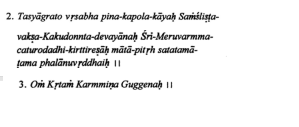
KuTila, of which SAradA is shown to be the immediate descendant, was used during the 7th century, as pointed out by Kamal Prashad Sharma. Screenshots of inscription on Nandi Bull image, for instance, are given as follows:


M C Joshi provided the following translation for part 1:
Om, Meruvarman as a result of his meritorious deeds constructed a Meru type of prAsAda on the summit of Himavanta mountain with ChandrashAlA, prAggrivaka, and various mandapas containing mural paintings and the whole fabric on a plan named as nava-nAbha.
Vogel’s translation of part 2 is as follows:
In front of the structure was installed a bull, fat of cheeks and body solid of breast and hump exalted vehicle of the God (Shiva). This is glorious work of Sri Meru Varman (famous) over the four oceans (tending) to increase continually the spiritual fruits of his parents himself.
Made by Craftsman Gugga.
It is interesting to note that craftsman has been given prominence in an inscription, rather giving an autograph, inking his name. However, Gugga’s idols, as Vogel point out, convey an idea of the style of “those famous statues of LalitAditya of Kashmir on which KAlhAna bestows so much praise.”
 |
| Lakshana Devi Temple in Bharmour (Sourc; Wikimedia commons) |
This temple of Lakshana Devi has significance for many other reasons too. It is post-Gupta era Hindu temple in Himachal Pradesh dedicated to DurgA, and dates to the second half of the 7th-century, and is in part one of the oldest surviving wooden temples in India, as pointed out by Goetz and Bernier. The temple interior presently has a sandhara plan found in the Hindu texts on architecture, with an ardha-mandapa, a mukhya-mandapa, a circumambulation path and a rectangular sanctum, as pointed out by Omcharan Handa. The mukhya-mandapa is a gathering zone in front of the sanctum and marked by six square pillars. Further, Handa notes that the original plan of the temple may have been an open twin-tiered hansakara plan, and that snow and weather may have led the community to add structure to protect the temple, modifying it first into a nirandhara plan of Hindu temple architecture, and therefrom to the current sandhara plan.
Comments
Post a Comment