Black and White Picture of Raja Ugar Singh of Hindur, 1840-1850 (from Archer's book on Punjab Hills Paintings) Picture the year: 1795. The foothills of the Shivaliks are tense, echoing with the tramp of armed men and the grinding pressure of regional rivalries. Down in the valleys, Raja Ram Saran Singh Handuriya of Handur (modern-day Nalagarh) is caught in a grinding political bind. For years, Handur has ridden the coattails of Kangra’s aggressive campaigns against its bitter historical rival, Bilaspur (then known as Kahlur). But looking out across his contested borders, Ram Saran Singh faces a heavier, more haunting question: Does he continue serving as a satellite to Kangra’s ambitions, or does he break away, side with Maha Chand and Bilaspur, and reclaim a fractured sense of Rajput honor? The friction between Handur and Bilaspur was rooted in continuous struggles over strategic border zones, crucial river-crossing points, and the Satgarha (seven forts) territory. Because Handur...
 |
| Svayambhu Sri Chakra at Sharika Devi in Srinagar (Temples of India) |
In the state of Jammu and Kashmir, particularly in Kashmir valley, Sharika Devi is a very important goddess in the Kashmir Tantra traditions, particularly of the Vaishnava Tantra, which is an even rarer school. This Devi, the Aadi Devi or Mother Goddess, is often identified by scholars with Tripurasundari or Lalitha Devi. The city of Srinagar, where Sharika Devi's temple, also known as Pradyumna Peetha, is located on Hari Parbat, has an interesting legend to it. Hari Parbat is a corruption of the name ShAri, the name for the Myna bird, because the Devi had assumed the form of the Myna and then threw a stone held in her beak on an Asura, Jaludbhava, which had by the time of reaching the ground become a mountain, a Parvata. The temple is unique in more ways than one, for Sharika Devi is worshipped in the form of a svayambhu or self apparent Sri Chakra on the surface of a rock. This Sri Cakra is what gives the city of Srinagar its name. The temple around the time of the Sri Cakra had in fact been set up by King Pravara Sena II as per Kalhana's magnum opus on Kashmir history called Rajatarangini. This city was then known as Pravarapura, as has been noted even by the Chinese traveller Huen Tsang in 6th century AD, right up to the 12Century AD.
As per Moti Lal Pushkar, a former lecturer in Kashmir, Rajatarangini notes the following about the idol of Sharika Devi:
Sharika Devi's Murti is beautiful. Her, image is made of black stone. She is Mother Durga having 18 arms. The Cosrriic Energy is beyond any name and form and She is Eternal force of God. She is matter (Sat), soul (chit) and bliss (ananda). I offer Pranams to Her to protect me, the seeker of asylum under her pious feet.
But where is the idol? Learned scholars of the community have noted that the idol was taken away from the temple in Srinagar sometime between the 11th and the 14th century. From the Rajatarangini it is noted that
There was a Murti of Sharika Devi made of glazed black stone. The same was taken away to Sarthal Kishtwar by king Ugra Deva in 1170. A.D. Kashmir was in a state of turmoil then.
Hutchison and Vogel in their history of the Hill States note the name of Ugar Dev as a ruler of Kishtwar without dating him; however, given the order of the kings, it is very highly likely that this Ugar Dev could have been around only in the 14th century. Also, within Kishtwar, the idol is believed to have arrived in the 14th century AD. What is important to note is that 11th Century AD is the year that Mahmud Ghazni invaded Kashmir, albeit unsuccessfully. A known iconoclast, he tried invading Kashmir twice; by the beginning of the 14th Century A.D. Kashmir had come under Islamic rule, with the Lohara Dynasty having come to an ignominious end as the last Hindu dynasty, and Rinchan having become the first Muslim ruler. Islam in the valley was a violent shock, with iconoclasm ruling the roost, with such infamous figures ruling the region as Sikandar Butshikhan. So it is highly likely that the turmoil of the valley and the threat of iconoclasm had a big role to play in the reasons why the idol was perhaps shifted out to save it.
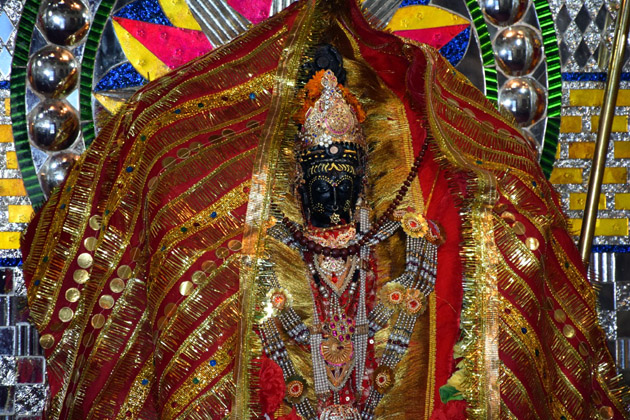 |
| Sarthal Mata in Kishtwar |
Ugra Dev, is believed to have taken it away with him and reinstalled it at a place in Kishtwar called Sarthal. Interestingly, there is a temple in Kishtwar at a place called Sarthal. The temple itself notes that SArthal MAtA, also known as AshtAdasha BhujA Devi or AthrAh BhujA Devi came to Sarthal in 14th century with Ugra Dev, and it is claimed that the murti worshipped there is the same as the one brought in the 14th century. Her mela or fair is a very big affair in Kishtwar. The memory of Kishtwar within Kashmiri Hindus was very strong, as even today some Kashmiri Brahmins also believe that Sharika Devi actually rests at Sarthal in the winters to escape the bitter winter of Srinagar. The Kashmiri Pandits even today regard Sarthal as a place of wonder and magic, essentially retaining the memory of the Tantrism that Sharika Devi represents. Interestingly, the entire Chenab valley region has remained a major place of refuge for Kashmiri Pandits, successive generations of whom have settled in the Valley, retaining several traditions and cultural practices.
Maej Sharika is matron goddess of Kashmir. The Sri Yantra out of which the whole body of Sri Vidya evolves is representation of her and was conceived through her. Even though her murti is not present there in Kashmir anymore but still we have Kheer Bhawani, another representation of Shakti in Tulmul region.
ReplyDelete